
Basic Military Training, Lackland AFB Texas
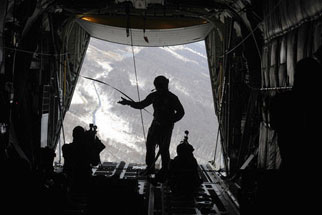 Sandwiched between enlistment processing and technical training, Basic Military Training is an intense training program designed to prepare you for those times when national requirements place duty ahead of self. Getting the most out of basic training demands your highest level of personal focus, effort and teamwork.
You’ll hear us calling it BMT, “summer camp,” and a few other things depending on company. Whatever you call it, get ready for eight and a half weeks that will turn you, at the very least, into a well trained and ready Airman. By graduation, you’ll meet the fitness requirements that make airmen physically durable in almost any situation.
Basic Military Training is designed to teach you the critical importance of discipline, teamwork and foundational knowledge you’ll need to succeed as an airman. It will also prepare you physically as a warrior in the profession of arms. Successful completion earns you the privilege of proudly wearing the blue uniform of the most powerful Air Force in the world.
Prior to reporting for duty, you should begin your training at home. Following a recommended workout schedule, 3-5 times per week for at least the six weeks before you attend BMT will help you get ready for the challenges you’ll face in basic training and beyond.
Basic Military Training will challenge you physically and mentally. You’ll learn to follow instructions, help others and work as a team. You will grow with each success, and you’ll gain confidence in your ability to achieve all of your dreams and goals.
On your assigned departure date, you will return to the Military Entrance Processing Station (MEPS) for a review of your enlistment papers and your physical testing results. You will be sworn into the active-duty Air Force during a special enlistment ceremony.
The Air Force will arrange and pay for your trip to San Antonio, Texas, where you’ll be met and transported to Lackland Air Force Base. This is where you will enter Basic Military Training (BMT) and get your first real taste of life as a member of the Air Force.
Lackland Air Force Base, home of the 37th Training Wing, is also known as the Gateway to the Air Force. The Gateway, as its name implies, means that enlisted personnel in the active Air Force, Air National Guard and Air Force Reserve all begin their careers here by completing Basic Military Training.
Historically, training has been the mainstay of the base and that continues today with a wide variety of organizations dedicated to training today’s expeditionary Airmen in a myriad of skills.
Military Training Flight
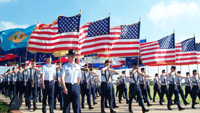 You will join about 45 other new airmen in a group called a Training Flight. You will meet your Military Training Instructor (MTI) who will take you to your dormitory and help you get settled in. The first few days are spent completing paperwork, receiving equipment and uniforms and gaining a clear understanding of the basic rules everyone follows in the Air Force.
In addition to classroom studies, each Flight will have daily physical conditioning, periods of time for dormitory maintenance, study, personal hygiene and preparation for the upcoming day’s events.
You’ll find out what it’s like to work with great people and realize what it’s like to be a part of a team. You’ll take pride in what you’ve accomplished, and the friendships that you’ve made in the Air Force will last a lifetime.
There will be a lot of yelling, a lot of orders and a lot of chances for you to screw up. Don’t let it get to you!!! There is no possible way you’ll be doing anything “right” for the next few weeks. The first night at BMT will be the worst. More than anything, you’ll be in a state of shock as the finality of your decision to enlist starts to sink in. Hang in there!!! Start to think of this as the first day of the rest of your life. All of the things you thought you knew, everything you always thought you were capable of is soon to become a faint, and funny memory.
The whole purpose of BMT is to break down the walls of individuality. Once that’s done, you’re going to be amazed at the team you’ll be built into, that of the US Air Force.
Airman Battle Gear
Moisture Wicking PT Shirt

Condor Tactical Cap
ABU Accessories
There are going to be times where you feel lonely, homesick, exhausted…. You may think no one notices this, but just when you think you can’t take it anymore, when you think no one cares, the least expected thing happens. Your TI will give you a little word of encouragement. This is where the pride in what you belong to begins to develop. These feelings only continue to grow as you complete each week of BMT. When you graduate, you will feel more pride in yourself, the Air Force and your country then you ever felt possible. Oh, and that TI you swore hated you, the one that you might have thought you hated right back will be more proud of you than you could ever fathom. You’ll have a mutual respect for each other that will last forever. Those six weeks may be the longest of your life, but they are also the most valuable. You’ll be able to draw on those experiences for the rest of your life.
When you arrive at Lackland, you will be referred to as “trainee.” Your reporting statement will be, “Sir/Ma’am, Trainee XXXXX, reports as ordered.” After completion of the 5th week of training, you will be referred to as “Airman.” It’s a good idea to rehearse your reporting statement before you arrive. You will be assigned to a “flight,” a group of 30-60 trainees within a “Squadron.” Each flight will have several TI’s assigned to guide the trainees through BMT. The first few days (Zero week) will be spent getting haircuts, issuing equipment and clothing, and explaining the basics of dorm life. Most days begin at 0445 (4:45 a.m.) and end at 2100 (9:00 p.m.). You will receive three meals per day.
Weekly Training Schedule
Week 0 – The Air Force doesn’t recognize the first half week of training with a designation other than 0 as it consists primarily of getting the basics setup. Airmen can expect to undergo their new military haircut, to be assigned a bunk along with all basic necessary equipment and clothing, to go through a nutrition and fitness analysis, and to receive their individual and division assignments.
Week 1 – The first official week will introduce airmen to all basic drills and to the core values of the Air Force. In addition to which, airmen will be trained on weapons identification, receive cultural sensitivity training and spend some time being counseled about their educational and career options.
Week 2 – An introduction to basic war skills is presented during the second week. Airmen will learn how to properly handle and maintain their weapons, and will also be given the basics of how to survive during combat, particularly in harsh environments.
Week 3 – The third week focuses on the medical aspects of being deployed; all airmen will have the hands-on opportunity to learn how to quickly and effectively provide basic CPR and emergency medical techniques while under fire.
Week 4 – Countering a terrorist threat is the main focus of week number four and all airmen will be given anti-terrorist training, including chamber training and how to follow the Air Force’s security programs.
Week 5 – Building on the previous four weeks, week five will test the skills that the airmen have developed while also introducing them to more advanced combat techniques. Leadership and pre-combat mental preparation will be focused on, along with how to properly handle a public relations situation. Airmen will take their first written test by the end of week five.
Week 6 – The sixth week of boot camp is referred to as The Beast. Airmen will spend the week in an intensive Survival, Evasion, Resistance and Escape (SERE) operation and will be critiqued afterwards on all aspects of their performance.
Week 7 – Week seven places an emphasis on proper airmanship. Airmen will learn the history of the Air Force and will receive training on many vital topics, including recovering from combat stress, the importance of ethics and suicide prevention. All airmen will also undertake a second written test and will have their drills, courtesies and reporting evaluated.
Week 8 – Airmen will start the eighth week by undertaking their final written test. They will then receive a briefing from their Commander, along with briefings specifically about technical school and town passes. Before prepping for their graduation ceremony airmen will receive another military haircut and then they will participate in their graduation parade.
Each week has its own specific focus and it is therefore hard to pinpoint a typical day during Air Force basic training, however, each day does follow a similar routine. Airmen will be woken up at 0445 by the playing of reveille and will be expected to report for physical conditioning by 0500. The next hour will be spent exercising, comprised of an alternating schedule of aerobic exercises and running. From 0600 – 0615 airmen will eat breakfast, after which they’ll be expected to get their dorm in shape. After these daily basics the schedule can alternate quite a bit from week to week, but what follows is rough example of what to expect.
0800-1130 – Classes, drills, immunizations and other necessary functions of the day.
1130-1230 – Lunch
1300-1700 – This is the part of the day when most of the classroom instruction and testing takes place.
1700-1800 – Dinner
1900-2045 – Clean up the dorm, get gear ready for the next day and shine boots.
2100 – The playing of Taps, followed by lights out. Graduation is a recognition you will earn. It marks the end of your Air Force basic military training and the beginning of your career as a military professional in the World’s Greatest Air Force! You will enjoy the pride of accomplishment you’ve earned through courage, determination, and the will to succeed. You will attend a public ceremony attended by your friends and family as they come together to share in this significant and rewarding event.
Academic Training
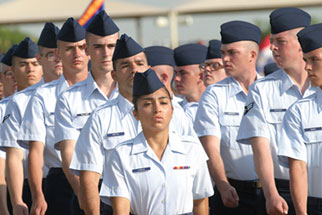 You’ll attend approximately 40 hours of classroom instruction to learn about all aspects of Air Force life.
You’ll want to spend any ‘available time’ studying for your academic test (while waiting for a haircut, in line for clothing issue, or prior to lights out). Your score on the academic test will be one of the factors used in your selection for Honor Graduate.
In the end, you will have gained a better understanding of a wide range of military subjects, and a better understanding of your own abilities. You will also learn the importance of the Air Force’s core values that will help guide you as you lay the groundwork for a rewarding career in the US Air Force! Examples of academic training subjects: Air Force History, Air Force Organization, Financial Management, Lifestyle Fitness, Customs and Courtesies, Human Relations.
After completing BMT, airmen begin technical training in their career field specialties, primarily at five installations: Goodfellow, Lackland, and Sheppard Air Force bases in Texas; Keesler AFB, Miss.; and Vandenberg AFB, Calif. Each base is responsible for a specific portion of formal technical training airmen require to accomplish the Air Force mission. Highly trained instructors conduct technical training in specialties such as aircraft maintenance, civil engineering, medical services, computer systems, security forces, air traffic control, personnel, intelligence, fire fighting, and space and missile operations.
Commissioned officers attend technical training courses for similar career fields at the same locations.
ASVAB Practice Tests
The Ultimate ASVAB Practice Pack provides you three full-length ASVAB practice tests with answer key and unlimited access to the ASVAB Online Practice Center. Modeled After the CAT-ASVAB with over 2000 questions in the question pool – each practice test is different every time you take it. See your AFQT score and Subtest scores at the end of each practice test. Track your scores and history online to monitor your progress and watch your scores increase! 100% Satisfaction Guaranteed.

Airman’s Guide

Score High on ASVAB

Air Force Officer’s Guide

Official USAF Elite Workout
Physical Fitness – Prepare for BMT
Check out the new US Air Force Physical Fitness Standards .
Part of Air Force life revolves around physical fitness. Throughout your Air Force career you’ll be asked to meet certain physical-conditioning standards. The Air Force physical-conditioning program is designed to ensure Air Force members are physically capable of handling military duty, while maintaining good personal health and looking sharp in uniform.
Physical conditioning at BMT can be rigorous if you’re not prepared. A physically fit trainee has a greater chance of avoiding injury and graduating on time. Start an exercise program three times a week for 45 minutes a session. The program should emphasize muscular strength, flexibility and cardio-respiratory endurance. Muscular strength is defined as the maximum amount of force a muscle can produce in a single movement. A training program using free weights is an ideal method to attain muscular strength and endurance.
A well-rounded exercise program also requires stretching before and after any exercise. Five to seven minutes of stretching before and after a workout is a good standard. Stretching should be performed in a slow, controlled manner for 10 to 30 seconds with some tension in the muscle. Avoid bouncing or using jerky movements because this may cause injury. Stretching helps flexibility and prevents common injuries, such as shin splints.
In addition to strength, endurance and stretching, you should be prepared for the cardio-respiratory endurance challenge at BMT. Build your endurance through aerobic exercise of at least 20 minutes three to five times a week using such exercises as cycling, swimming, roller-blading, running and lap swimming.
Succeeding at BMT could be a matter of mental and physical preparation.
Basic Military Training Graduation Fitness Requirements
Your Air Force basic training will involve extensive marching, conditioning classes, and the completion of a challenging obstacle course. Upon graduation, you will not only be able to meet these requirements, you’ll be in the best shape of your life. Check out our section on push ups improvement to prepare for your training.
How hard is the fitness program? It’s rigorous and challenging. The program includes 1-hour daily workouts, 6 days a week with additional daily remedial sessions as required. Three days are dedicated to a strength building regimen (pushups, crunches, leg lifts, etc.) and three days reserved for aerobic training (running and sprinting). You need to prepare before you arrive.
How will you be evaluated? The first weekend you arrive, you’ll have an initial physical fitness evaluation–on pushups, sit-ups, and a timed 2-mile run. Your weekly progress will be monitored and you’ll need to pass your final evaluation in order to progress.
Fitness training will not end with your final evaluation. You’ll need to pass a 2 1/2-mile motivational “Airmen’s Run” in the final week of training in order to graduate.
Are you motivated? Check out our new section on Air Force Special Operations.
Some select Air Force career fields such as Tactical Air Controller, Combat Controller, or Pararescueman offer Airmen the unique opportunity to attend highly specialized courses including the elite Army Ranger School and Airborne School.
Deploying soon? Check out our Afghanistan Deployment Packing List and prepare for your deployment in support of Operation ENDURING FREEDOM.
Want to be on the cutting edge of air combat? Find out more about Enlisted crew positions on Predator UAV Drones.
Air Force Changes BMT Physical Fitness Standards
Teamwork is paramount to all that is taught during BMT and physical fitness is no exception. The most physically fit male and female flights each week receive a “Fitness Excellence” streamer to display on their guidon. Flights are also expected to complete the 2.5-mile Airmen’s Run in flight formation. By the end of basic training, all airmen will have run at least 2.5 miles, a major accomplishment for many who had never even run a mile before entering basic training.
The person who oversees both basic and technical training for the Air Force and has advocated, for over a year, more vigorous fitness training in BMT, applauds the increased physical standards BMT has put in place.
More information on US Air Force Physical Fitness Standards.
USAF Core Values
- Integrity First
- Service Before Self
- Excellence in All We Do
In 1995, The Honorable Sheila E. Widnall, Secretary of the Air Force and General Ronald R. Fogleman, Air Force Chief of Staff, approved these core values for the United States Air Force. The Air Education and Training Command and the United States Air Force Academy were tasked with promulgating these core values throughout the Air Force at every level. This initial education has been completed. Air Force commanders and schools for professional military education continue to hold these values up for the inspiration and guidance of new generations of military professionals.
Program offers Path to Academy Commission for Airmen
Each year, regular airmen on active duty and airmen serving in the Air Force Reserve and the Air National Guard receive appointments to the Air Force Academy – 85 slots are available for the regular airmen and 85 slots are available for those in the Air Force Reserve and the Air National Guard. Refer to AFI 36-2019 for directions for applying for direct appointment to the Academy and AFI 36-2021 for applying to the USAFA Preparatory School.
For more information, click here for our Leaders Encouraging Airman Development (LEAD) Program Pamphlet.
To compete for either, you must complete AF Form 1786 and have your unit commander complete a statement on your character, ability and motivation to become an officer. Submit the form and statement through your unit commander and MPF and forward it to:
Office of Admissions
HQ USAFA/RRS
2304 Cadet Drive, Suite 2300
USAF Academy, CO 80840-5025
The form must arrive no later than January 31 for the class entering the following June. Additional information about the Academy and the Prep School may be obtained by calling 1-800-443-9266, DSN 333-2520, or commercial 719-333-2520.
Previous Performance
We’ll evaluate your leadership potential through your record of participation in athletic activities, including team or individual sports and nonathletic activities, such as class offices, public speaking, Civil Air Patrol or scouting. Your grade transcripts from high school and from any preparatory school or college you may have attended after high school will determine your academic potential. We’ll also consider your performance on active duty and recommendations from supervisors.
Selection Criteria
We consider all candidates (regular or reserve) on a competitive basis for 85 appointments to the Academy and 50 appointments to the Preparatory School. Examination results and previous performance determine selections. We’ll notify you of your qualification and selection status in early May. Airmen not accepted for direct entrance into the Academy are automatically considered for the Prep School.
Check out other Scholarships for Veterans.
Search Your Air Force Records
Looking for historical information such as old class photos or rosters of your Basic Training class? Have questions about your previous Air Force units or want access to past records? Try our comprehensive military records search resource.
Improve Your Test Scores
Looking to boost your SAT scores? Check out the new 32 Most Effective SAT Math Strategies and boost your score by 100 points.
ASVAB Practice Tests
The Ultimate ASVAB Practice Pack provides you three full-length ASVAB practice tests with answer key and unlimited access to the ASVAB Online Practice Center. Modeled After the CAT-ASVAB with over 2000 questions in the question pool – each practice test is different every time you take it. See your AFQT score and Subtest scores at the end of the practice test. Track your scores and history online to see how you are improving –100% Satisfaction Guaranteed.
Check out the rest of the books in our Air Force Bookstore
Check out the Air Force Chief of Staff Reading List
Check out our section on Veterans’ Scholarships
Military Discounts | Military Calling Cards | Military Pay | Space-A Travel | Cable Descrambler | Aviation Colleges


