
|
|

Marine Corps Basic Training
is demanding. Prepare yourself for Boot Camp, mentally and
physically.
The Toughest Training
Without doubt, Marine boot camp is more challenging -- both physically
and mentally -- than the basic training programs of any of the other
military services. Not only are these requirements much higher, but
recruits are required to learn and adhere to the core values of
Honor, Courage, and Commitment.
Recruits arrive at boot camp. Gear is issued, and a battery of physical
examinations is conducted to ensure safety. The Initial Strength Test (IST)
is then administered. Later they will learn weapons handling from
trained experts and complete the 11-obstacle Confidence Course.
It has been said time and time again by former Marines that Marine Corps
recruit training was the most difficult thing they ever had to do in
their entire lives. In order to train the world's most elite fighting
force, it has to be that way.
During this time the recruits can receive letters but nothing else — so
please do not send gifts or supplies. This is Recruit Training, so don't
address letters with "Marine" or a rank, like "Private." This is a title
they will earn after they successfully complete training.
USMC Recruit Training
Marine Corps Recruit Depot (MCRD) is one of the birthplaces of basically
trained Marines. It is here where America's young men are transformed
into Marines. We believe that Marines are forged in a furnace of shared
hardship and tough training. This shared, intense experience creates
bonds of comradeship and standards of conduct so strong that Marines
will let nothing stand in their way. This belief will continue to be the
basis upon which we make Marines.
Holding on to the high character of the Marines of the past, we look for
ways to inculcate the strong values that have become synonymous with the
Marine Corps. Through MCRD’s challenging recruit training the Marine
Corps is preparing its Marines for the 21st century.
Marine Corps recruits are trained not only physically and mentally, but
morally as well. Forming the bedrock of any Marine's character are the
Core Values -- Honor, Courage and Commitment. By incorporating these
values into recruit training, the Marine created is not just a basically
trained, morally conscious Marine, but also a better American citizen
who will return to society following his or her service to this country.
Taking Up The Challenge
It has been said time and time again by former Marines that Marine Corps
recruit training was the most difficult thing they ever had to do in
their entire lives. In order to train the world's most elite fighting
force, it has to be that way.
Upon arrival at MCRD, a new recruit begins a virtually non-stop journey,
the end of which results in the transformation of that recruit into a
new Marine.
Recruit Receiving
The first stop is
at Recruit Receiving, where new recruits spend the first few days of
their recruit training experience. Here they will receive their first
haircut and their initial gear issue, which includes items like
uniforms, toiletries and letter writing supplies. During this time
recruits will also be given a full medical and dental screening, and
take the Initial Strength Test. This test consists of a one and a half
mile run, sit-ups and pull-ups to test recruits to see if they're in
shape to begin training.
Forming
Forming is the period when recruits are taken to their training
companies and they "meet" their drill instructors for the first time.
During Forming's 2 days, recruits learn the basics: how to march, how to
wear their uniform, how to secure their weapon, etc. This period of time
allows recruits to adjust to the recruit training way of life before the
first actual training day.
Drill
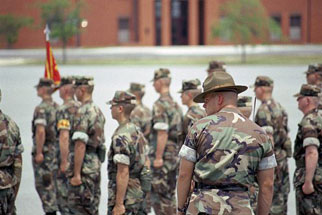
Drill is the basic way in which platoons march and move from place to
place. At first, recruits will practice just staying in step with the
rest of the platoon and the drill instructor. However, as training
continues, the platoon becomes a well-oiled machine performing
synchronous, complex drill movements. During recruit training, platoons
will also compete in two drill competitions. Drill is mainly used to
instill discipline, team pride and unit cohesion.
Physical Training
Physical Training, or "PT" as it is often called, comes in many
forms aboard MCRD. Recruit training uses a progressive physical
training program, which builds up recruits to Marine Corps
standards. Recruits will experience Table PT, a period of
training in which a drill instructor leads several platoons
through a series of demanding exercises while he demonstrates on
a table. Recruits will also run, either individually or as a
platoon or squad. Other PT consists of obstacle courses, circuit
courses, or 3-, 5- or 10-mile conditioning marches.
Academic Training
Recruits will also exercise their minds through academics training in
subjects ranging from Marine Corps history, Marine customs and
courtesies, and basic lifesaving procedures. Recruits will also take an
academic test while in recruit training.
Core Values
The Corps' Core Values are Honor, Courage and Commitment. These values
make up the bedrock of a Marine's character. During recruit training,
recruits are taught these Core Values and the numerous others attached
to them, such as integrity, discipline, teamwork, duty and esprit de
Corps. Drill instructors, recruit training officers and Navy chaplains
teach specific Core Values classes, but drill instructors also talk
one-on-one with recruits after other training events to see what values
were learned and how they affect the recruits. For example, a drill
instructor might talk about overcoming fears after rappelling or not
giving up after a long march. For more on core values, please visit
Marine Corps Core Values.
Confidence Course
The Confidence Course is an 11-station obstacle course that helps
recruits build confidence as well as upper-body strength. Recruits will
tackle this course twice while aboard MCRD.
Combat Water Survival
Training in Combat Water Survival develops a recruit's confidence in the
water. All recruits must pass the minimum requirement level of Combat
Water Survival-4, which requires recruits to perform a variety of water
survival and swimming techniques. If a recruit meets the CWS-4
requirements, he may upgrade to a higher level. All recruits train in
the camouflage utility uniform, but those upgrading may be required to
train in full combat gear, which includes a rifle, helmet, flak jacket
and pack.
Field
Training
Field Training introduces recruits to field living and conditions.
During the 3-day field training evolution, recruits will learn basic
field skills from setting up a tent to field sanitation and camouflage.
It is also during this training that recruits go through the gas
chamber.
Marksmanship Training
Marksmanship training teaches recruits the fundamentals of marksmanship
with their M-16A2 service rifle. This training takes place over two
weeks, the first of which is called Snap-In Week. During this week,
recruits are introduced to the four shooting positions (standing,
kneeling, sitting and prone) and a Primary Marksmanship Instructor shows
recruits how to fire, how to adjust their sights, how to take into
account the effects of the weather, etc. Recruits also have the
opportunity to fire on the Indoor Simulated Marksmanship Training
machine. During the second week of marksmanship training, recruits
actually fire a known-distance course with ranges of 200, 300 and 500
yards. Recruits prepare for rifle qualification on Friday of that week.
Field Firing Range (FFR)
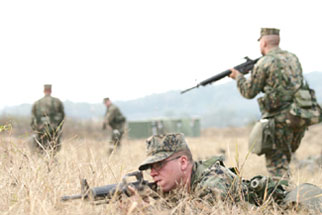
FFR is a portion of training devoted to firing weapons in a field
condition. During marksmanship training, recruits learn how to fire at a
single target while in a stationary position. During FFR recruits learn
how to fire at moving and multiple targets, while under low-light
conditions and wearing their field protective (gas) mask.
The Crucible
"We have two missions in
the Marine Corps -- to win battles and make Marines," said Col. Bob Hayes,
assistant deputy chief of staff for operations and training at the recruit
depot here. "The Crucible is one piece of that effort."
The
Crucible
emphasizes trainee teamwork under stress. "Recruits get eight hours of
sleep during the entire 54 hour exercise," said Sgt. Roger Summers, a
Delta Company drill instructor in the 1st Recruit Training Battalion at
Parris Island. "They get two-and-a-half MREs and they are responsible for
rationing out the food to themselves. Then we put them through tough
physical activities like road marches and night infiltration courses. They
march about 40 miles in those 54 hours."
It isn't long before the
recruits are tired and hungry, Summers said, but as they keep going they
realize they can call on reserves they never knew they had.
"Some of these recruits do
things they never thought they could do," he said. "Some of them come from
middle-class homes where everything has been handed to them. Others come
from poorer homes where nothing was ever expected of them. If they finish
the Crucible, they have accomplished something."
One recruit put it best. "I
am going to finish this," he said. "And when I do, it will be the most
positive thing I have done in my life."

Making the Corps |

Into the Crucible
USMC boot camp |

Marine Guidebook |

USMC Workout |
More
Marine Corps Books
Delta Company begins the
Crucible at 3 a.m. with a six-mile road march from their barracks to Page
Airfield, the Crucible site. Once there, recruits -- and that's the only
thing the drill instructors call the trainees -- place their gear in huts
and prepare for the first of four four-hour events.
Each event has a number of
"warrior stations" that the team of recruits must work together to
overcome or solve. Each station is named for a Marine hero and the drill
instructor has a recruit read a brief explanation of how the hero's
actions exemplify the Corps and its values.
"I choose a different
leader for each station. That way, all the recruits understand what it's
like to be the leader and what they have to do to be a follower," Summers
said. "For some of them, they want to run everything. They can't admit
that a recruit who may not have been the sharpest in previous training has
a good idea. Sometimes it's the quiet one who has the idea and no one will
listen.
"You see the team
learn as they go along," he continued. "At the beginning, they just charge
ahead without a plan and without asking if anyone has an idea. By the end
of the
Crucible you
see them working together better, getting advice from all team members and
solving more of the problems."
One warrior station, for
example, is built around an enemy-mined rope bridge that the recruits must
cross with their gear and ammunition boxes. They have only a couple of
short ropes and their personal gear to solve the problem. At another
event, recruits run into firing positions and engage pop-up targets with
10 rounds in two magazines. Recruit teams battle each other with pugil
sticks in yet another event.

The recruits grab food and
water when they can. After the first two events comes a five-mile night
march. "The night march was the toughest thing we've done here," said
18-year-old Pfc. Josh Lunceford of Charleston, W.Va. "The whole company
went on it and whoever led it set a real fast pace. You couldn't see very
well and people were tripping over stuff, and everyone was tired."
The recruits hit the rack
for four hours of sleep, then begin another day and finish the final two
events. "On the second day they are tired and hungry and it really starts
to show," said Capt. John H. Rochford, Delta Company commander. "They
start getting short with one another, but they realize after the first day
they have to work together to finish. No one gets through the Crucible
alone."
At the end of the second
day, the recruits go through a night infiltration course and then hit the
rack for another four hours. When they get up, they face a nine-mile march
and the end of the Crucible.
The march begins at 4 a.m.
and, at first, is done quietly. Recruits limp along, because no one wants
to drop out this close to the end, Summers said.
As the sun rises, the
recruits cross DI Bridge. Once across, the drill instructors start Jody
calls and the recruits join in. As they get closer to the main base, the
Jody calls get louder until they reach the Parade Deck. The recruits form
up around a half-size replica of the Marine Corps Memorial -- also known
as the Iwo Jima Memorial. There, a significant transformation takes place.
"We're not just giving them
basic training, we're turning them into Marines," Rochford said. "There's
more to being a Marine than knowing how to fire a weapon. There's a whole
tradition behind it, and we want these recruits to measure up to the men
and women who went before them."
A color guard raises the
flag on the memorial. The chaplain reads a prayer specifically written for
the finish of the Crucible, and the company first sergeant addresses the
recruits. Then the drill instructors present each of their recruits with
the Marine Corps insignia -- the eagle, globe and anchor. He shakes their
hands and calls them "Marine" for the first time. Many accept the honor
with tears streaming down their faces.

I do solemnly swear (or affirm) that I will
support and defend the Constitution of the United States against all
enemies foreign and domestic; that I will bear true faith and allegiance
to the same. That I will obey the orders of the President of the United
States and the orders of the officers appointed over me, according to
regulations and the Uniform Code of Military Justice. So help me God.
--excerpt from defenselink
websites for informational purposes

Marine NCO
Handbook |

Marine Officer's
Guide |

Semper Fi
Business Leadership |

Marine Corps
Decorations |
New USMC Battle Dress
Utilities Uniform
There is a brand new version of the utility uniform. About the only
carryover from the old uniform is the idea of rolling sleeves inside out.
Some
of the new features:
Gone are the lower pockets on the blouse.
Pocket flaps that once featured plastic buttons now use Velcro.
Trouser adjustment tapes were scrapped for an integrated elastic waist
adjustment.
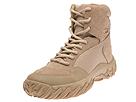
Brown suede boots replace black boots, complete with the Marine Corps’
eagle, globe and anchor on the ankle.
Pockets also were added to the upper parts of the sleeve.
The eagle, globe and anchor also appear embroidered on the new slanted chest
pockets, the same as the traditional octagonal utility hat and the new
“boonie” hat to be added to the new issue.
Collars were redesigned to be smaller and more comfortable.
Cargo pockets on the legs feature an elastic enclosure.
Belt loops were changed to accommodate the upcoming issue of Marine
“rigger’s belts” in varying colors, which reflect Marines’ achievements in
the Corps’ new martial arts program.
The blouse was even designed to make it easier for Marines to tuck it into
their trousers in the field.
For the field, knee and elbow pad inserts were added to the uniform, “an
issue that went over very, very well in testing,” Patricio said.
Subdued rank for the field is coming. Rank insignia that appeared silver
will now be black, and once-gold ranks will be brown. But that’s only for
the field. Traditional metallic insignia will be worn in garrison. There is
no change for enlisted insignia.
The Biggest Change
But the most obvious change is the pattern, called Marine Pattern.
The new uniform features a computer-generated pattern patented by the Marine
Corps. The pixel-style pattern “is more effective dry and wet,” Patricio
said. And it’s coming in both woodland and desert patterns. It will be worn
only by Marines and sailors assigned to duty with the Fleet Marine Forces,
in accordance with regulations.
The uniform’s fabric also has been improved. Uniforms now are wrinkle-free
and feature a permanent-press crease, eliminating the need for pressing and
starching, which is said to degrade fiber.
Designers combined a longer-lasting fabric for the uniform with a lighter
material.
Researchers chose a heavier trouser fabric to address increased durability
while lighter blouse fabric will be used for increased comfort, Patricio
said.
Even the seams on the trouser got a makeover. Reinforced diagonal seams
replaced horizontal seams on the current uniform. The diagonal seams are
expected to last longer by spreading the stress of the seam over a greater
area.
Officer Candidate School |
Military Flight School |
Women in the Military |
Military Aviation | Army
Basic Training
© 2008
Baseops.Net -
Terms of use
|